上海錾科自动化科技有限公司——流量自动化仪表供应商。 联系电话:18001874240
语言选择:



The Paradigm Shift: Traditional mechanical paddle flow switches are rapidly being phased out by solid-state thermal dispersion flow switches due to the latter's zero-moving-parts, maintenance-free reliability.
Critical Specifications: Technical buyers must prioritize extreme low-flow sensitivity (1 cm/s for water), programmable software damping delays to eliminate false trips from transient bubbles, and premium metallurgical construction (SUS 316L).
The High-Tech Frontier: High-flux thermal management is the new baseline. Solid-state flow switches now serve as critical, high-reliability fail-safes within AI Data Center CDUs, Battery Energy Storage Systems (BESS), and 700-bar Hydrogen Fuel Cell Infrastructure.
In my 15 years navigating the industrial automation and fluid control sectors, I have reviewed countless post-mortem failure analyses. The most painful lesson is always the same: the failure of an inconspicuous, sub-tier component can cause a catastrophic shutdown of a multimillion-dollar asset.
If precision sensors represent the nervous system of an industrial complex, the flow switch is its vital "whistleblower."Hidden deep within complex piping networks, this component monitors the velocity of cooling loops and process fluid lifelines. It sounds the alarm at the exact millisecond a flow rate drops below critical thresholds, stopping terminal thermal overrunsbefore they can begin.
As modern industry transitions toward ultra-high-power densities—typified by megawatt-scale AIcomputing clusters and high-pressure hydrogen ecosystems—legacy fluid monitoring methods are hitting their physical limits. This guide deconstructs the core physics of modern flow switches, decodes their critical technical datasheets, and provides a framework for integrating these vital components into next-generation industrial architectures.
For decades, industrial piping relied heavily on mechanical flow switches (such as paddle, target, or magnetic baffle designs). Their operational logic is simple: the kinetic force of a moving fluid physically displaces a spring-loaded paddle, which mechanically triggers a microswitch.
[Legacy Mechanical Switch] -> Fluid Push -> Physical Displacement -> Mechanical Wear -> Jamming Risk
[Modern Thermal Dispersion] -> Fluid Flow -> Thermal Dissipation -> Solid-State Analysis -> Zero Wear
However, this intrusive, contact-based approach harbors severe vulnerabilities in high-uptime, modern industrial configurations:
Mechanical Fatigue: Continuous cycling causes spring relaxation and pivot wear, leading to drift in the set-point calibration.
Particulate Binding: Any particulate matter, scale, or biological fouling present in the fluid can easily lodge in the mechanical hinges, causing the switch to jam in either a false-positive or false-negative state.
Pressure Drop ($\Delta P$):Large mechanical paddles introduce localized flow restrictions, causing parasitic pressure drops across the line.
To eliminate these vulnerabilities, thermal dispersion (thermal mass) flow switches have become the industry standard for high-reliability applications.
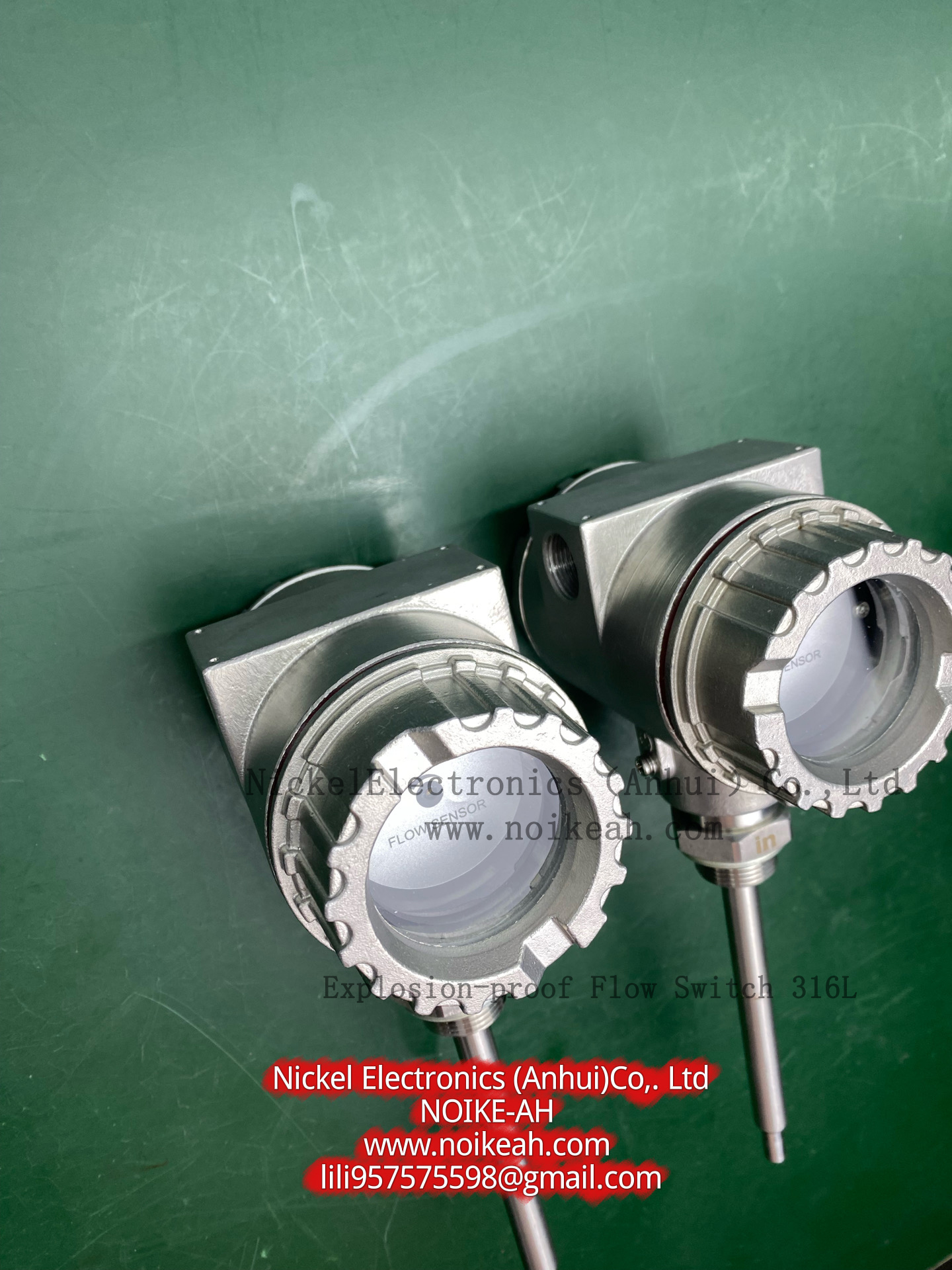
The foundational advantage of a thermal dispersion flow switch is itssolid-state, zero-moving-parts architecture. The immersion probe contains two high-precision Resistance Temperature Detectors (typically PT100 platinum RTDs) housed within a rugged metallic tip:
The Reference RTD: This sensor remains unheated and continuously measures the true, ambient temperature of the process fluid ($T_{amb}$).
The Heated RTD:Thissensor is continuously supplied with a regulated electrical current, maintaining its temperature at a constant, elevated level above the fluid ($T_{hot}$).
When the fluid is completely stagnant, a maximum and constant temperature differential ($\Delta T = T_{hot} - T_{amb}$) is established between the two RTDs. As the fluid begins to move past the probe tip, it absorbs and carries away thermal energy from the heated RTD via convective heat transfer. The rate of this thermal dissipation is directly proportional to the mass flow velocity of the fluid.
The faster the fluid moves, the more rapidly the heated RTD cools down, causing the temperature differential ($\Delta T$) to shrink. An embedded microprocessor continuously monitors this thermal change, compares it against a pre-calibrated curve, and switches an output relay (e.g., PNP/NPN or dry contact) the moment the velocity crosses the engineered threshold.
Because this method relies entirely on thermodynamic heat transfer rather than physical kinetic force, it eliminates mechanical wear, resists fouling, and delivers a maintenance-free lifecycle spanning millions of operating hours.
B2B technical buyers frequently make the mistake of evaluating flow switches purely on pipe size and cost. To ensure long-term system stability, an engineer must accurately decode three core technical performance vectors:
Mainstream Standards:Water/Liquids:$1 \sim 150\text{ cm/s}$; Gases: $20 \sim 2000\text{ cm/s}$.
Engineering Insights: It is critical to recognize that thermal dispersion sensors measure velocity at the probe tip, not volumetric flow rate. The defining strength of this technology is its exceptional sensitivity to low-flow thresholds. In micro-channel cooling networks, volumetric flow rates may be exceptionally small, resulting in velocities that cannot actuate a mechanical target. A high-performance thermal switch can reliably detect a velocity drop down to a creeping 1 cm/s, providing an early warning long before absolute stagnation occurs.
Mainstream Standards:Typical response time of$2 \sim 8$ seconds; integrated programmable damping software delays up to 60 seconds.
Engineering Insights: Engineers accustomed to the instantaneous mechanical snap of a spring-loaded paddle often view the multi-second response of a thermal sensor as a drawback. In field operations, however, this slight thermal inertia acts as an excellent low-pass filter against transient noise.
Industrial fluid lines frequently encounter brief entrained air pockets,localized vapor flashing, or rapid pressure spikes caused by pump handovers. A mechanical switch reacts instantly to these anomalies, causing false alarms and unnecessary system trips. A thermal switch allows engineers to configure a smart damping delay (e.g., 3 seconds), effectively masking these harmless transient events and avoiding costly false shutdowns.
Mainstream Standards: Nominal operating pressures from$25 \sim 100\text{ bar}$ (with high-pressure variants rated up to $200\text{ bar}$); Standard construction: SUS 316L Stainless Steel.
Engineering Insights:Because the immersion probe is machined from a single, continuous piece of bar stock, there are no structural joints, internal dynamic O-rings, or thin diaphragms to fail under stress. This monolithic construction turns the sensor probe into a high-strength pressure barrier capable of operating in aggressive chemical fluids and high-stress environments without risking external leaks.
To appreciate the engineering value of solid-state flow monitoring, we must look at how these principles protect infrastructure in three rapidly growing technical sectors.
The explosion of high-density AI accelerators and multi-chip modules (MCMs) has pushed rack power densities beyond 100 kW, completely exceeding the capabilities of traditional air-cooling infrastructure. Modern hyperscale data centers use Coolant Distribution Units (CDUs) that circulate either high-purity water chemistries (such as deionized water blends) or specialized engineered fluids (such as dielectric fluorinated liquids) through micro-channel cold plates directly attached to the silicon.
The Critical Pain Point:The thermal mass of a high-performance GPU running at peak compute loads is extremely small relative to its heat output. If a localized fluid interruption occurs, the silicon temperature can spike past safe operating thresholds within seconds, causing immediate thermal throttling, permanent structural damage, or localized delamination of the semiconductor packaging.
The Thermal Switch Solution:Solid-state thermal switches are integrated directly into the liquid cooling manifolds and individual server blade inlets. Because they introduce near-zero pressure drop ($\Delta P$), they do not degrade the overall hydraulic efficiency of the pump loops. Beyond detecting total flow loss, their high sensitivity allows them to detect slight, progressive velocity drops. This characteristic allows them to serve as anearly-warning diagnostic tool for localized particulate clogging within the micro-channels or for minor, hidden fluid leaks before they cause an electrical short.
Grid-scale Lithium-ion Battery Energy Storage Systems (BESS) packaged in modular outdoor enclosures require tight thermal management to maintain cell equilibrium and prevent catastrophic failures.
The Critical Pain Point:During high-rate charging or discharging cycles, battery cells generate substantial internal heat. If a liquid-cooling branch pump fails or a cold-plate header suffers an internal flow imbalance, localized hotspots develop rapidly. This localized thermal stress is the primary trigger for thermal runaway, which can initiate a self-sustaining chain-reaction fire that destroys the entire enclosure.
The Thermal Switch Solution: Installingzero-moving-parts thermal flow switches directly into the battery pack manifolds ensures continuous flow verification. Unlike mechanical switches, which can experience false trips from the constant mechanical vibrations of surrounding pumps or transport movement, the solid-state thermal sensor remains completely unaffected by physical shock, providing highly reliable monitoring throughout the service life of the energy storage asset.
The emerging hydrogen economy requires fluid handling under extreme physical conditions, including high pressures, cryogenic temperatures, and highly volatile gas mixtures.
The Critical Pain Point:In high-capacity hydrogen refueling stations (operating at nominal pressures up to 700 bar) or heavy-duty PEM electrolyzer stacks, process components are exposed to high pressure differentials and the threat of hydrogen permeation. Standard alloys suffer severely from hydrogen embrittlement, which causes microscopic cracking, catastrophic structural failures, and highly dangerous high-pressure gas leaks.
The Thermal SwitchSolution: In these setups, flow switches must be manufactured from specialized, high-grade SUS 316L Stainless Steelwith optimized nickel and chromium content to resist hydrogen embrittlement. Whether deployed in the ultra-high-pressure gas lines to verify hydrogen distribution or in the low-temperature auxiliary cooling loops to manage process temperatures, these switches provide the necessary ruggedness to prevent leaks and structural failures.
To ensure successful field deployment of a flow switch in a critical engineering design, adhere strictly to these three deployment rules:
Thermal dispersion flow switches calculate volumetric flow velocity by measuring heat transfer at a specific point within the pipe's velocity profile. Any upstream hydraulic disturbance—such as a partially closed ball valve, an abrupt$90^\circ$ elbow, or a concentric reducer—creates turbulent eddies and velocity profile distortion.
Field Protocol: Always install the flow switch probe with a minimum of 5 pipe diameters (5D) of straight, unobstructed pipe upstream, and a minimum of 3 pipe diameters (3D) downstream. This configuration allows the fluid to re-establish a stable, laminar boundary layer before it contacts the sensor tip, ensuring precise and predictable switching thresholds.
Upstream Disturbance (Valve/Elbow)
                                 │
                                 ▼
         ┌───────────────────────┐             ┌────────────────────────┐
         │                       │   Probe     │                        │
  ───────┘                       └─────▼───────┘                        └───────
   Flow ──>   Turbulent Eddies      Laminar Flow       Stable Recovery    ──>
  ───────┐                       ┌─────────────┐                        ┌───────
         │                       │             │                        │
         └───────────────────────┘             └────────────────────────┘
         |<───── Minimum 5D ────>|             |<───── Minimum 3D ─────>|
If a liquid cooling system is prone to continuous air entrainment due to poor reservoir de-aeration or minor vacuum leaks on a pump suction line, the sensor will encounter gas bubbles. When an entrained air pocket passes over the heated RTD, the thermal dissipation rate drops instantly compared to the liquid phase. This transient drop can mimic a low-flow condition, leading to a false alarm.
Field Protocol:Ensure the loop includes a mechanical air separator upstream. Position the flow switch probe horizontally or at a slight upward angle ($45^\circ$) relative to the pipe axis. Avoid top-vertical mounting where buoyant air pockets naturally collect, and avoid bottom-vertical mounting where heavy particulates settle. Additionally, tune the device's internal software damping delay to smoothly ride through transient air pockets.
In high-stakes industrial projects—such as chemical processing units or international B2B equipment exports—an unverified or uncalibrated instrument introduces significant liability. The financial impact of an unscheduled shutdown or an environmental leak easily dwarfs the initialcost of the sensor.
Field Protocol:Specify instrumentation from manufacturers that provide complete material traceability reports (such as EN10204 3.1 certification) to guarantee true SUS 316L metallurgy. Furthermore, ensure the manufacturer performs factory calibration tailored to the specific operational fluid. Highly viscous dielectric fluids, glycol-water formulations, and hydrocarbons exhibit vastly different thermal conductivities ($k$) than pure water. Utilizing a flow switch with factory-calibrated curves designed specifically for your target process medium is the only way to ensure the long-term accuracy and safety of your system.
Manufacturers like NOIKE-AH, which maintain mature B2B process standards, not only guarantee genuine 316L metallurgy but also provide highly precise factory-calibrated curves for specialty fluids like dielectric fluorocarbons, giving your export machinery an unbreakable foundation of reliability.
To assist procurement and design teams in their technology evaluations, the table below highlights the operational differences between legacy and modern flow monitoring technologies:
| Operational Attribute | Legacy Mechanical Switches (Paddle / Target Type) | Modern Thermal Dispersion Switches (Solid-State) |
| Moving Parts | Yes (Subject to mechanical wear and fatigue) | None (Zero physical wear, solid-state) |
| Minimum Reliable Velocity | $\approx 20 \sim 30\text{ cm/s}$ (Insensitiveto micro-flows) | 1 cm/s (Exceptional low-flow detection) |
| Pressure Drop ($\Delta P$) | Moderate to High (Displacement blade restricts flow) | Negligible (Low-profile immersion probe) |
| Fouling & Particulate Risk | High (Susceptible to mechanical jamming) | Low (Smooth, non-moving probe resists scale) |
| Signal Conditioning | Raw microswitch (Prone to contact bounce) | Integrated microprocessor with adjustable delays |
| Primary Failure Mode | Mechanical binding, spring fatigue, or seal leak | Electronic component end-of-life |
The demanding reliability requirements of modern industrial processes are rapidly making legacy, mechanical components obsolete. The transition from physical mechanical paddles to solid-state thermodynamic sensing represents a major evolution in underlying safety philosophy. By selecting a high-performance thermal dispersion flow switch, engineers can build a highly resilient, long-term line of defense for critical fluid and thermal management networks.